
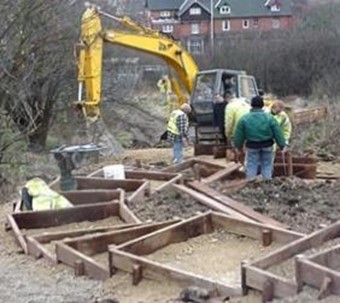
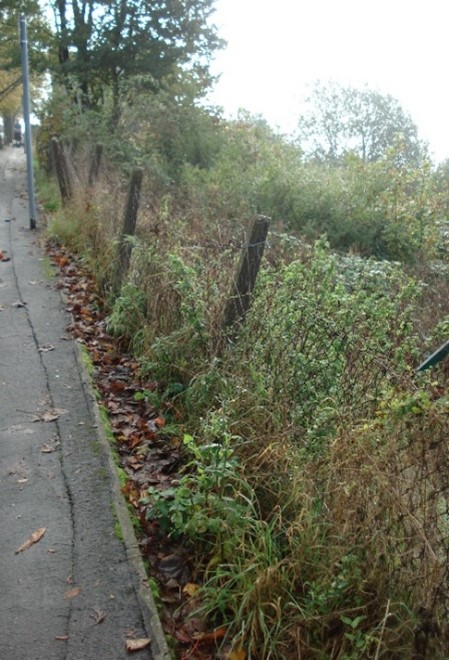
It’s our 21st anniversary and we are taking this opportunity to relate our story of how Liquorice Park came to be. In the 1990s the 4 acre site consisted of deteriorating allotments eventually becoming a neglected eyesore. Residents were fed up looking at it. A public meeting was called to agree on some funds available from the Halfway Up the Hill Festival which was held at the Joiners Arms annually but had ceased. At the meeting the community agreed to use the funds for improving the site. The result was a grant from the Countryside Agency and Lincoln Council offering a 999 year lease. A Board of Trustees was appointed and a constitution created. Liquorice Park was born. The hard work began…….
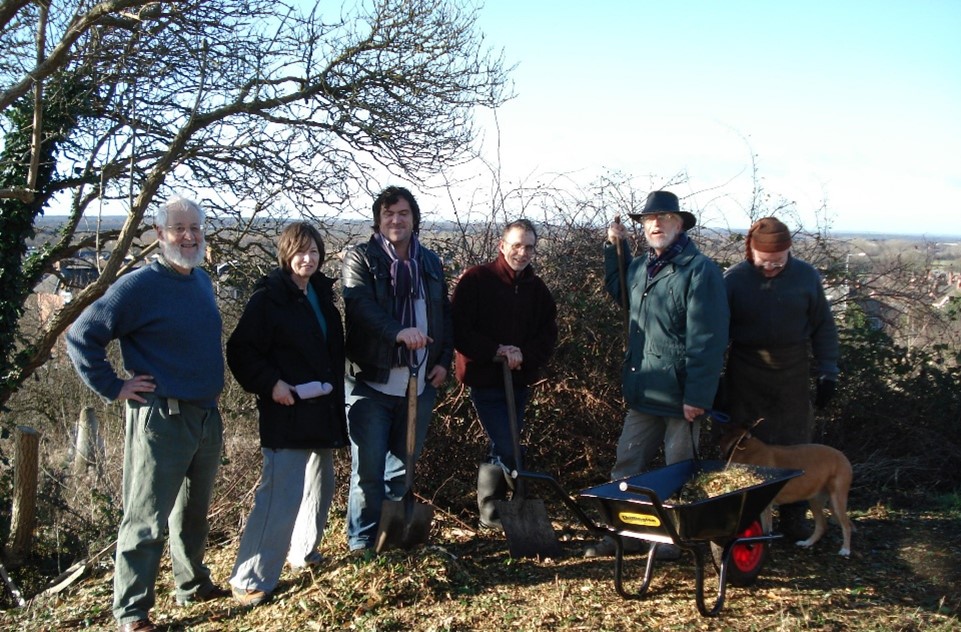
Chris Padley, Nicky Watson, Andy Tomlinson, Bob Speck, Dudley Thomson, Richard Bett
People always ask why the name? It’s easy. Liquorice was believed to have been cultivated and it still is. If you ask us, we will show you. The root is boiled and made into the black stuff. Love it or hate it? It’s a bit like marmite!
Here’s a reminder of the original aims of the Trust and an explanation on how we are upholding the vision:
- Make a substantial contribution to the life of the whole community
- Be able to be enjoyed by people of all ages and physical abilities
- Be open and evident to visitors to the locality as well as inhabitants
- Be an attractive place for people to exercise, meet others and pursue leisure activities and pastimes consistent with shared enjoyment of the whole land
- Include an area suitable for community events and celebrations
- Include significant “natural” areas where people can enjoy nature and wildlife at first hand
- Make a positive contribution to the local environment and respect the established character of the area
- Remain safely and conveniently accessible from inhabitants’ homes.
We are trying to stay true to the community’s vision and make the park welcoming for everyone.
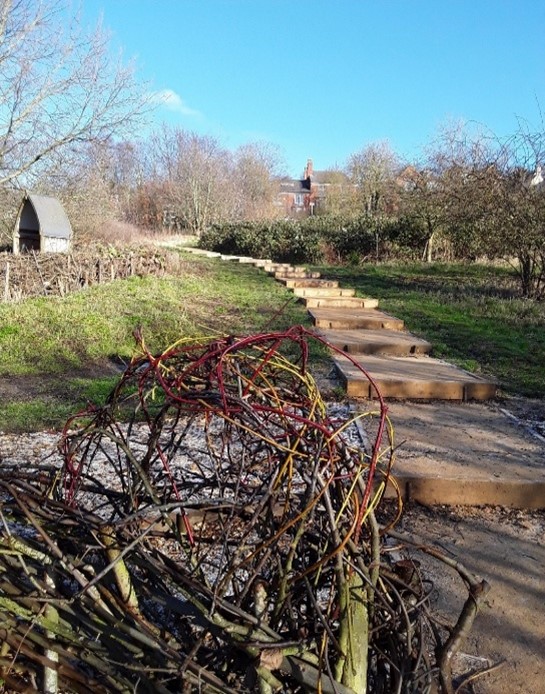
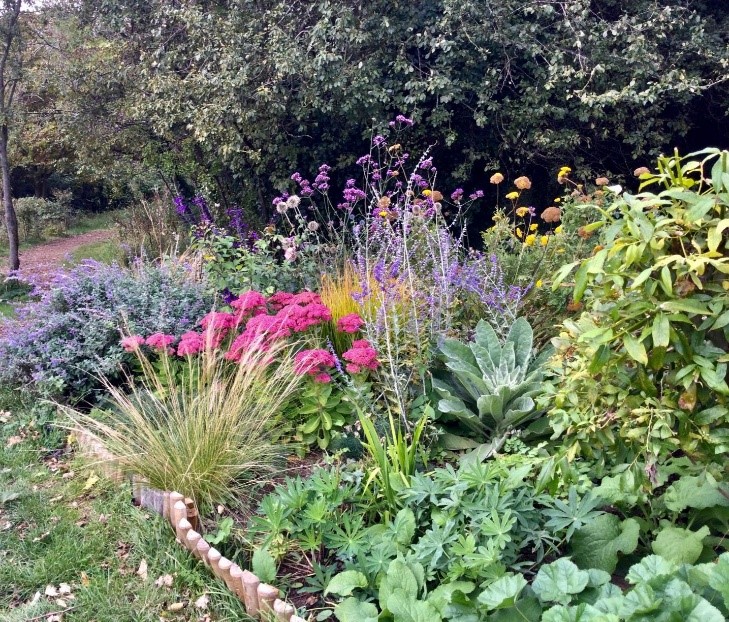
You may have noticed we are sited on quite a slope! The new paths we are cutting through the brambles in the central area are aimed at most physical abilities but unfortunately not for wheelchairs. It will never be perfect because of the financial constraints and slippy clay conditions but it does allow more access. Cutting back some brambles has had great benefits for the wild flowers and plants that sulked beneath the thatch. We have a minimum 25% of uncultivated areas and the remainder consists of managed meadows, orchard, flower borders, herbs, trees, shrubs and dead hedges. The mosaic of habitats encourages a greater variety of wildlife.
Who could have predicted a worldwide pandemic? All our plans for events in 2020 were in tatters. However the park has provided a welcoming, calm oasis in which to exercise and take a breath of fresh air. Our countryside in the City. The volunteers have continued their work throughout lockdown and we’ve never seen so many people! It’s been a pleasure to meet you all and chat about the park and volunteering.
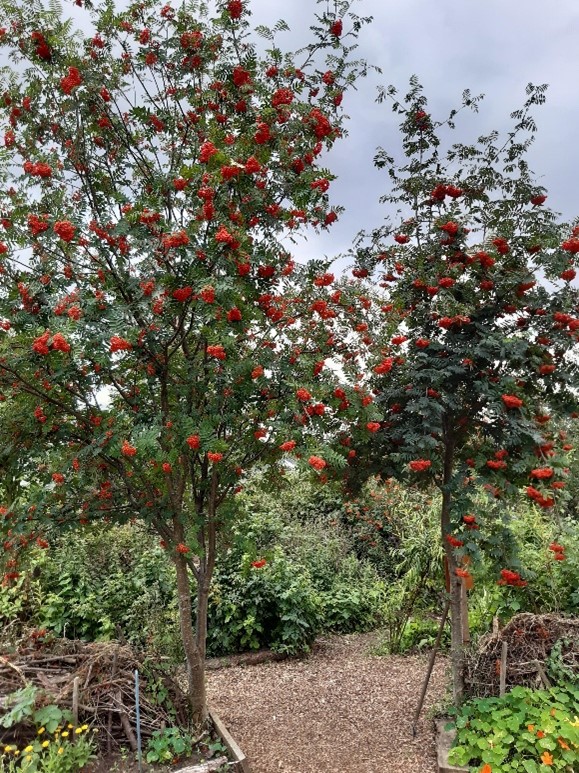
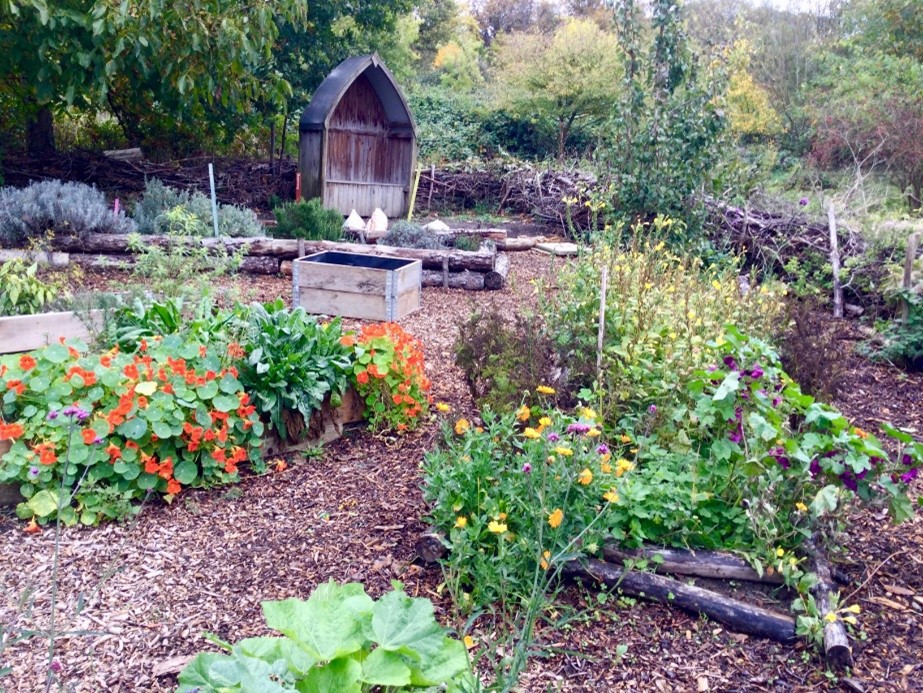
You are welcome to help yourself to the plums, sloe, raspberries, blackcurrants, blackberries, sweet chestnuts, apples and walnuts as they ripen. The herb garden offers parsley, thyme, sage, rosemary, lemon verbena, calendula, dill, nasturtium and coriander so please continue to visit and enjoy the fruits of nature.
The seating in the renovated herb garden has proved a runaway success. It’s become a venue for family meetings and picnics. The picnic benches were given by a kind donor and renovated by our volunteers. We aim to continue planting with climbers around the arbour seat and lavender and achillea to attract the pollinators.
Ongoing Work
Maintenance of Steps and Paths. This is a top priority. The ‘Steps R Us’ volunteers have worked hard and have renewed the main steps top to bottom. Two steps a week over summer 2020. It took a lot of cake to keep them going.
Paths were created and topped up by an army of volunteers and tons of steaming woodchip. We never seem to have enough as the park eats it.
Meadows are cut twice a year with scythes in a traditional method.
Compost Area. A new roof and extra water butts to increase water conservation to be installed in 2021
Water Meter Connection to be completed in Spring 2021
Cornfield Meadow and Wildflower Area above the performance area to be seeded. The first year should be very colourful. The second year and ongoing will see the beginning of the wildflowers.
New Projects, Sponsors, Donations
A £2000 grant from the John Dawber Trust is for renovating the performance area. Work has yet to start due to lockdown restrictions.
£500 has been donated by a family for a plaque on the viewing platform in memory of their parents. A beautiful place for a memorial. The money is to be spent on repairs to the platform as agreed by the Trustees.
£500 has been donated by a resident who loves the park.
We have applied to Lincolnshire Co-operative to become one of their 2021 Community Champions. If we are successful, the money raised will go towards the repair of the viewing platform.
Travis Perkins donated the new arbour which is in the herb garden.
Our sponsors are very generous and without them the park would not thrive. A big thank you to them all. We have no other income and rely on donations from the public and sponsorship.
Things to see and do
- The viewing platform on Carline Road. Magnificent views across Lincolnshire to the south and west. Sunsets are wonderful
- The spring daffodils and newly planted snowdrops
- The topiaries: dog, cat and very fat mouse in the performance area
- The herbaceous flower gardens and herb garden
- Birds watching. See how many species you can spot.
- The upper and lower meadows with beautiful wild flowers that have been patiently encouraged. Can you spot any of the following: cowslip, agrimony, betony, yellow rattle, knapweed, kidney vetch, ladies’ bedstraw, field scabious, cranesbill, wild marjoram, rest harrow, selfheal, birds-foot trefoil, oxeye daisy, vetch, ragwort, goat’s-beard, rough hawk bit, red and white clover
- Orchard: apple, plum, pear and sweet chestnut trees. Local apple varieties including the quaintly named Peasegood Nonsuch (trees 2 and 8). Tree number 21 is an Isaac Newton and is a direct descendant of the tree at Woolsthorpe Manor, where the great scientist observed that apple falling.
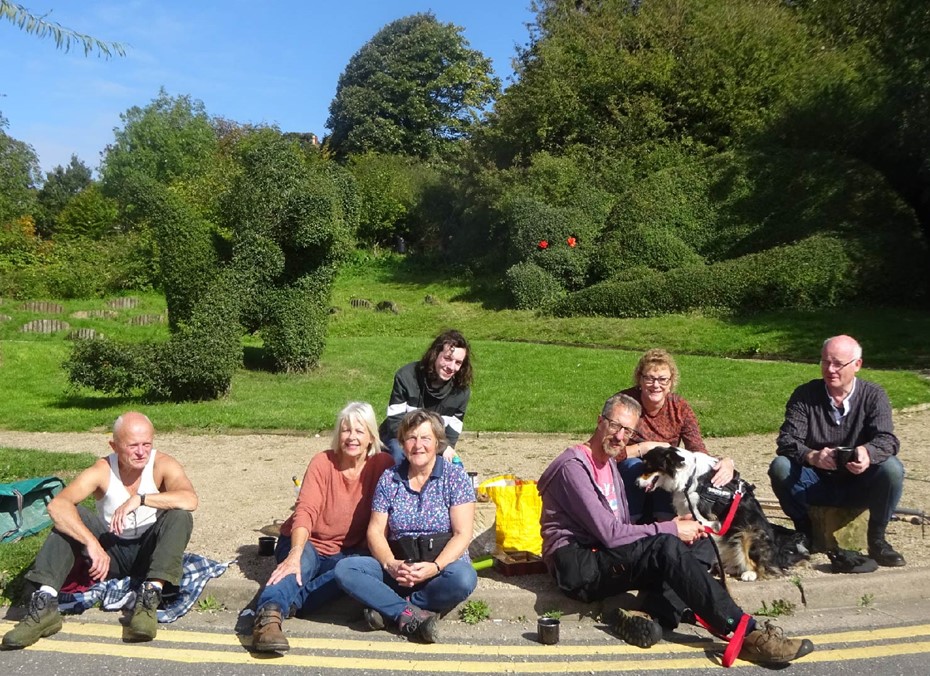
Paul, Penny, Alison, Nathan (rear), Richard, Helen (rear) Merlin the dog and Michael
Our community is backing us. The City council, County council and Police are supporting us and that helps the Trust in making the park a safe place to visit.
We realise how important nature and green space is to our well being and how precious our park is. Liquorice Park is loved and cherished. We know that because you have told us! We always try hard but know we can always improve. Your views are always welcome.
Keep up to date with us at liquoricepark.co.uk or facebook.com/liquorice.park/
There are some cracking photos of the park on Instagram.
Happy 21st birthday Liquorice Park. See you all soon.
Many years ago I studied at Warwick University and taught in Tanzania with a Bob Speck. If it’s the same one it would be good to hear from him
I am living near Swansea